Posts

Showing posts with the label student-centered classroom

Class Agenda Slides

Image
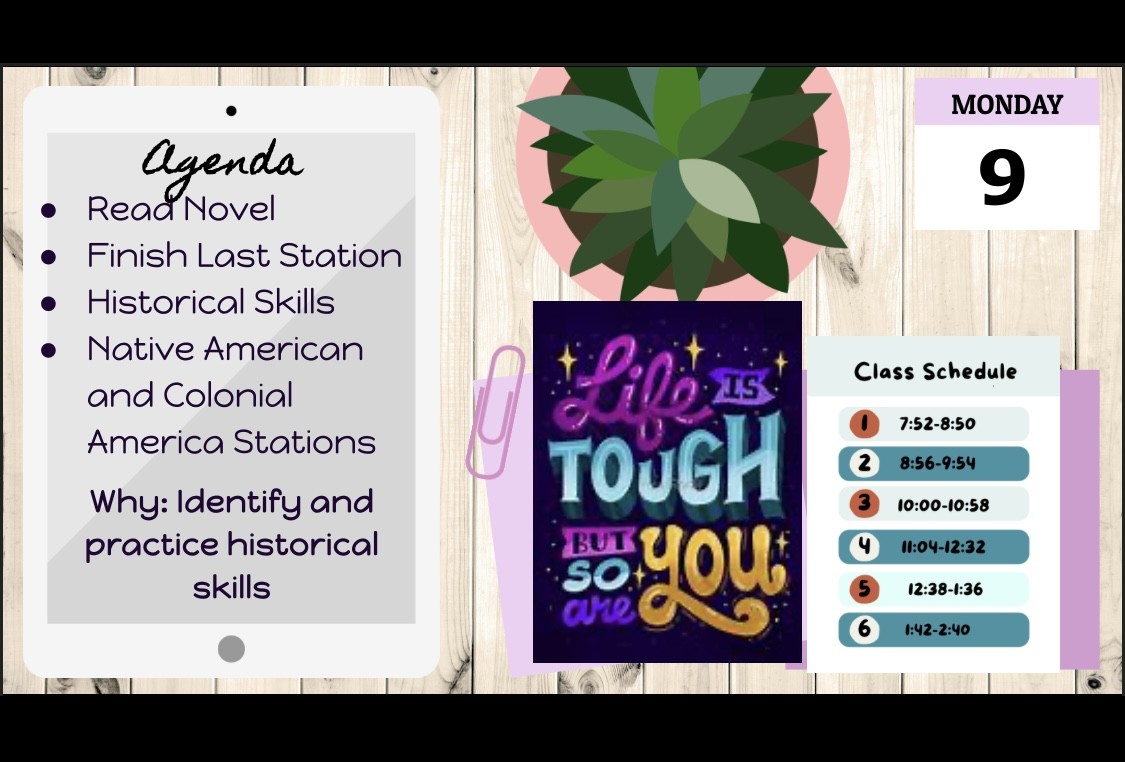
It's important for students to know what they are learning at the start of class. Studying History is important and I strive to help my Historians appreciate what we do in class everyday. My Cooperating Teacher always had a place on her chalkboard to post daily activities. I continued this practice, and as a young teacher, was encouraged to not only state the "WHAT" of the lesson but also the "WHY" for the lesson.  I now create digital slides for my Agenda and reset my MacBook every hour to display this slide on the monitor as students are walking in to class. The slide is also available on Schoology for students to view. The Agenda lists the day/date, gives a bullet point list, daily schedule (which changes for Pep Assemblies, Half Days, etc.) the WHAT and WHY of the lesson, and an inspirational quote. It's always reassuring for me to see students look at the agenda as they're preparing themselves for the hour. I realize that my efforts are important an...

Harkness Success

Image
  Our first Harkness was a terrific learning experience for all of us. I was upfront and honest with my students that I'd never done this with a class before and we would all simply try our best.  It was recommended that I run three discussion groups during one class so that more students would have the opportunity to speak for a longer period of time. I divided students into groups and students not in Harkness had individual work to accomplish. The groups moved their desks into an oval, I read the essential question, and put 10 minutes on the timer.  Essential Question: Why is it important for people living in America today to live up to citizen responsibilities? Students were asked to consider the Three Branches, the Bill of Rights, and their roles as citizens. I also asked them to connect citizen rights to the history we had already learned this year (for example, what life was like in the colonies before and during the American Revolution). My historians were encourag...

Working on a New (For Me) Classroom Discussion Model

 School is going well this year--it's been very busy!  In the search for new activities and assessments that will provide deep learning opportunities for all students I've decided this year to attempt the Harkness discussion. This type of discussion is a student-centered model that especially benefits English Language Learners. I observed a teacher in my department that is adept with this model and she gave me a lot of insight and ideas as to how I can bring it to my students. I was also fortunate to see how her students successfully and impressively take control of their learning while experiencing this discussion. Detailed planning really helps students feel comfortable, especially before their first discussion, and this is in my mind as I decide what and how we will use this in History. My research and insights are compiled in a power point reference:  Harkness Discussion Guide.pptx  I've learned so much, and I will update as we take on our first Harkness discussi...

Successful Strategies for Newcomers

Image
 It's been a very busy start to the school year. We are building community and laying a foundation for a good year in US History and Language Support-History. Today's post is about the success we are finding in LS History, specifically with listening, speaking, reading, and writing practice activities. My students in this class are very capable and strong learners, but they struggle with the English language. Striking the balance between finding and creating age-appropriate materials for newcomers that are challenging, yet language-appropriate, is always essential. Two activities my Historians have really enjoyed so far are playing Gimkit to review the concepts related to the 5 Themes of Geography, and, to my surprise, performing in front of their classmates! I created a short two-person skit related to ordering food in a restaurant (we are going out to breakfast as a Language Support team early next week). Students watched my co-teacher parapro and I perform the skit first, th...

Adding to the Ambiance of our Classroom

A classroom that's too quiet can actually be distracting. Our usual classroom environment is one of group work and discussion. There are often times, though, where independent concentration (in short bursts) occurs, and no noise isn't necessarily conducive to learning. It can be challenging to focus if people do not have something to hear while they're concentrating. I've played relaxing background music for years and found that all of us prefer some background noise while we are in class. My go-to music is usually instrumental classical, although I've been mixing it up to include instrumental modern music. Another instrumental soundtrack on heavy rotation during class is the instrumental Hamilton soundtrack. (Words in music can distract, and modern songs that students know might make them concentrate on the song, instead of their classroom activities.) This year I've really focused on adding more historical options and it's been successful. We have listened...

Supporting Students during Hybrid Learning

Image
  One of the bright spots this year is the opportunity to offer individualized help to students in a different format on a regular basis. It's called Student Support and runs four days a week after school. This is the chance for students to ask questions and for me to reteach concepts in a small group or individual setting on Zoom. I will regularly check for missing work or low grades on assignments, then either individually chat students that are virtual or email in-seat students to encourage them to attend (so as not to call students out in front of their peers). I have a decent amount attending most days.  Students will sometimes attend because they say it's a good place to still feel like they're in school and work, even if it's in a breakout room. I encourage them to turn off other devices and set aside time for them to take care of school responsibilities. (Devices and other distractions are a huge issue, as you can imagine.) I feel it's important for me to ke...

The Significance of Student Choice

 My students' National History Day projects are coming along, better than expected, if I'm honest. There are a few factors that are definitely helping--these students created projects last year in their Ancient Civilizations class. How fortunate that our 7th Grade teachers saw the value in these projects last year! It makes this undertaking less daunting for these now 8th Graders. It's just as challenging a project, but my students know what to expect and that makes a huge difference. The wealth of incredible resources from the National History Day and state History Day organizations make my role run so much more smoothly. These historians help teachers focus on guiding our students through their studies and I couldn’t do it without their help. Another factor is that the foundation has been set and my students understand I am there to support them. The student-centered classroom I strive for every year has been replicated as much as possible in the virtual environment. I am...

Remembering Who I Teach

Image
I have to always remember who I teach. I work with teens that want nothing more than to spend time with peers. That, of course, is something that has fallen to the wayside most of this calendar year, and almost all of this school year.  Building community has been a focal point of my classes before 2020, now it's imperative but quite challenging. Students will talk to one another, but mostly stay quiet and prefer to work in small groups, or alone. Being at home tends to make them feel more reluctant to share and speak up, unfortunately. My Social Studies colleagues introduced me to Gimkit last year. Gimkit is a gamified review that my students have really enjoyed. The company has come out with a version similar to an incredibly popular computer game and we played this version in class last week, as a review of the Constitution, Three Branches of Government, and the Bill of Rights. My students loved it and they came alive during our classes. I was overjoyed to hear them hollering (a...

This Week in History

Image
We have had a busy week! Students in US History participated in a Gallery Walk, examining primary and secondary sources related to some of the battles of the American Revolution. We also reviewed the concept of propaganda and applied that concept to some of the sources. This important understanding will assist students during their National History Day work.  Student Historians also used the National Archives DocsTeach app to analyze multiple primary sources about Valley Forge. They needed to figuratively weigh the evidence on a scale as to whether or not the documents would make them quit the Continental Army or encourage them to stay.  This exercise is beneficial for many reasons. One is that the students are working and thinking on a continuum.  Being able to weigh evidence is a critical life skill (and citizenship skill). Preparing students to problem solve in this way will benefit them, regardless of their career path. I was impressed to see th...

Blackout Poetry Revolutionizes Assessments in the History Classroom

Image
I've been utilizing blackout poetry as a means of assessing knowledge for a few years now  because it's one of the best ways to assess deep understanding of a topic. Yesterday's classwork was no exception. I've never used music from the hit musical "Hamilton" in my classroom before. I've wanted to but planning lessons seemed daunting because, frankly, many of the songs aren't student-friendly. I located a friendly version and decided to take the plunge--I'm so glad I did! We listened to and annotated the song two days ago and then wrote our poems yesterday. We are studying the New Nation and the seeds of discord surrounding Hamilton and Jefferson. The song "Cabinet Battle #1" tells the story of the negotiations into paying off state debts in the Northern states, creating the National Bank, and the creation of Washington DC (exciting, right?) I've never particularly cared for teaching this time period but I do now, thanks t...

GarageBand in the US History Classroom

Image
My full circle moment. Almost one year later. Monica Burns from  Class Tech Tips wrote an intriguing article about using GarageBand in the reading classroom  in 2016 and posted it on Twitter. I  blogged last July about how I'd like to use this with my Student Historians . That opportunity finally came and the result was profound, especially for one group of students. My History classes have studied the Civil War the past two years by completing an iMovie. I created a twist, though, each group studied one year of the war and ranked three events of that year they feel most strongly impacted the end of the war . Students needed to use investigative and discovery skills to learn about the entire war, then the impact of their focus year. Groups were required to find three primary sources related to those events, one Mathew Brady photograph from that year, and a piece of Civil War-era music (not necessarily from their focus year). The GarageBand article gave t...

Week One is In the Books!

The first week of school went by so quickly! Student Historians were busy taking part in various stations that represent important facets of our classroom this year. One station consisted of deciding, as a small group, what an ideal teacher, student, and classroom looked like (using details and sensory examples).  They completed  an online survey for me to get to know more about them as an individual (I now have a spreadsheet with a wealth of information regarding their likes, dislikes, and facts they feel I should know about them)! Another station had them explain, on a paper coffee cup, who in History they would most like to have a cup of coffee (or hot chocolate, or lemonade) with and why. Still another was a textbook and syllabus investigation searching for the "specifics" of the course. Students also surveyed one another to find out how they spent their summer and what they might have in common with their new table mates. These activities, as I later pointed...

Civil War iMovies

Student Historians were given one year of the Civil War to analyze (see Civil War Investigation iMovie post). The following video was the overall selection voted by my students from all classes and was entered into a district video competition. The video is excellent and a great example of the work we do in class. Bravo! Another video worthy of showcasing is presented below. This group also clearly followed directions and found excellent primary sources. Well done!

Civil War Investigation iMovie

Student Historians started their Civil War investigation this week. Teams were each given one year of the war from 1860-1865 (1860 was included because of the significant events that directly impacted the war) and will rank and justify 3 events they believe impacted the end of the war.  Project-based learning never gets old for me as an instructor. I find such joy in seeing the students interact, think deeply, and work together. I move from group to group questioning and guiding while team members sort through primary sources, storyboards, and apps and discuss and debate with one another. The sense of purpose is palpable and our class minutes tick away productively.  Today team members each chose one of five project roles: Producer, Director, Screenwriter, Special Effects Director, and, of course, Historian. Tomorrow each role will have specific tasks to complete, including deciding on the overall tone for the year being studied and developing justification for this t...

National History Day Wrap-Up

The Student Historians that competed at the Michigan History Day State Competition have so much to be proud of! They presented their projects and answered the judges' questions with detailed and knowledgeable responses.  The final results revealed that two of the three projects placed 3rd in the State of Michigan in their division and these students were alternates in case one of the top two entrants was unable to attend the National History Day Competition this June! (They found out today that the Finalists in their categories will all be attending and their projects are no longer needed this year.) Every one of my Student Historians has now capped off a fantastic year of learning and can look back on their experience with a great sense of accomplishment. Each and every one of my students created a persuasive and analytical project on a person in US History that was significant to them . I couldn't ask for anything more! My goal was to replicate a Genius Hour project ...

Persuasive Analysis Spark Video

Students created a persuasive analysis and used primary source documents to prove George Washington was or wasn't our nation's greatest president by creating a Spark Video. These Historians researched the Mount Vernon archives as well as the National Archives to locate letters, documents, and other items that should explain why he was or wasn't the greatest president. We have used this technology once before and it's clear students knew the ins and outs of this app much better this time. Here are two excellent examples:

The "Thinking Time"

Presenting a project-based learning opportunity to my students is always interesting for me but I had an epiphany this week.  I was explaining a persuasive iMovie trailer project to my first class of the day and noticed that while students were viewing this rubric the room got quiet-- very quiet . The normal sounds you would hear with 25+ adolescents in the room were non-existent. I realized then it was because the students were internalizing the work they would be doing over the next few days.  I observed this "Thinking Time"--these students were wondering how they would complete their project with group members I chose for them. It was a very cool moment but I wanted to see if it was just this particular class. Sure enough, the rest of my classes that day did the very same thing--they got really quiet and internalized the requirements. (I will now be looking for this phenomenon every time I present a project!) This made me realize, once again, the necessity of gro...

Reflecting and Preparing:Classroom Stations

Summer is a time for rest, relaxation, and reflection. As I reflect, I've realized one of the most successful changes I've made in my classroom over the years was to change the desk configuration to tables two years ago. It may seem like a small change but, as I've stated in previous posts, I now have 5 mini-classrooms of 6 students. I can get to know students and monitor their understanding of the subject matter so much better than with my previous setup of mini-rows, with students facing one another.  I now truly feel like I have a  community  of learners in our room (we have, in the past, made table coats of arms and mottoes to emphasize this concept). This setup also means that students have the opportunity to interact with one another more than ever before.  Increased student interaction has motivated me to work with, not against, the numerous student conversations that occur when students are facing each other. My plan: increase the use of classroom statio...

Final Projects: Historical Research and Analysis: Delving into One Year of the Civil War

Image
Student Historians completed their thematic historical research project (see previous post) this week. The timing was excellent--my 8th Graders needed to turn in their iPads Friday; they submitted their iMovie trailers to me on Schoology Wednesday and we started analyzing them on Friday. The trailers had many components and I believe the project objectives were accomplished--student groups needed to study one year of the war, decide upon and rank the top three events they believe directly led to the Union victory, and include at least one primary source document for each of the three events. Midway through the project I added another task--groups needed to find out who Matthew Brady was (he was the preeminent Civil War photographer--a photograph of his is shown below) and include at least one of the photographs he took during the war in their trailer.  photo: http://www.ohiohistoryhost.org/ohiomemory/archives/1575 Reflection is essential to deep learning--each student ...

Historical Research and Analysis: Delving into One Year of the Civil War

Image
Student Historians began Civil War era research today, with a twist. My goal was to create a thematic investigative project. Upon reflection, Civil War projects at the beginning of my teaching career centered on various historical groups and topics but I noticed how these projects were actually more like a research report than an opportunity to delve into deep thinking and learning. I needed create something to help this year's students continue to hone the analytical and technological skills they've developed this year and I think we are really going to like the results. Six groups of students will each focus on 1 year of the war, from 1860-1865. (I included 1860 because the Election of Lincoln and secession of South Carolina were huge events that directly led to war.) Each group will rank three events that had an impact on the end of the war, as well as locate and analyze a primary source document for each. They will compile this information into an iMovie trailer pr...