Posts

Showing posts with the label Visible Thinking

Tug of War Thinking Routine

Image
My Student Teacher and I are going to help students read with purpose and analyze the United States' entry into the Second War for Independence, also known as the War of 1812, by having students take part in the Tug of War Visible Thinking routine on Monday. I am a firm believer in the benefits of Visible Thinking and I find it to be an incredible equalizer for students of all levels. Every student can achieve deep learning in their own way through routines. They are challenging and promote rich discussion. Groups of Student Historians will be given cards with 9 topics/events on it. They will read a text section with purpose, looking to explain these topics in their own words. Students will place the cards on a continuum according to whether or not the United States should have entered the war. (The vote for war was the closest ever in American History.)  The most interesting part of the activity will occur when two student groups will compare and contrast their conti...

Historical Perspective and Peel the Fruit Thinking Routine

Image
Practicing historical perspective is an essential social studies skill. Historical perspective is being able to step into a historic situation and examine the motivations, biases, and beliefs of a person or group of people. Students have to revert to the beliefs of a group of people even if those beliefs completely contradict the views we have today. They must weigh decisions based on the situation of the time, not necessarily how situations are viewed today. The C3 Framework for Social Studies states that "Historical understanding requires recognizing this multiplicity of points of view in the past, which makes it important to seek out a range of sources on any historical question rather than simply use those that are easiest to find. It also requires recognizing that perspectives change over time, so that historical understanding requires developing a sense of empathy with people in the past whose perspectives might be very different from those of today." http://www.so...

Veterans Day Activities

Image
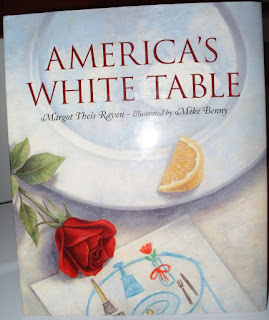
We have spent a few days this week focusing on modern history and the sacrifices our men and women in uniform have made for all of us. I found a story this summer about a military tradition I'd never heard of and wanted to share it with my class:  America's White Table , by Margot Theis-Raven, is a story of the Fallen Comrade Table. The tradition was started to honor all Missing In Action and Prisoners of War during the Vietnam War. An empty table is set for those who will never return and the items on the table symbolize the sacrifice of those who are missing. The Social Studies teachers at Boulan and I decided it would be powerful to replicate this table during the week surrounding Veterans Day and it was met with great reverence and respect by the students. Some classes read the book at the table and others completed a See-Think-Wonder Visible Thinking routine at the table. All students were moved by the display and felt gratitude for these soldiers. Eight...

Dred Scott Decision: Peel the Fruit Routine

Image
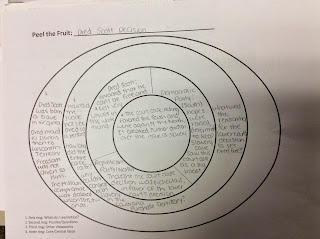
8th Grade Historians examined the Dred Scott Decision today. This landmark case reinvigorated the anti-slavery movement and propelled the United States toward war. Dred Scott, a slave, sued for his freedom because he had lived in free territory with his master. The Supreme Court ruled that Scott wasn't considered a citizen and therefore had no grounds to sue. The Court also stated that slavery couldn't be denied in the western territories. This ruling was a huge step back for all people against slavery. Students completed a Peel the Fruit Visible Thinking routine to delve deeper into the feelings and thoughts surrounding this case. The outer ring asks students to state what they notice about the topic. The second ring requires students to pose questions about the case and the impact it had on America. (These questions can be rhetorical.) The third ring requires students to practice an essential social studies skill: they must consider different perspectives and viewpo...

Political Cartoon Analysis: Zoom Out

Image
  Today's work in History centered on a Visible Thinking routine called Zoom Out. Students were asked to analyze this political cartoon in three stages: during the first stage I only showed the bottom of the cartoon. The second stage included the veto in Jackson's left hand and the third stage showed the entire image. Students needed to analyze the changes in their perspectives first, and then analyze the cartoon and its impact on them (whether they feel Jackson is a hero or a villain). Routines like Zoom Out challenge students' thinking in ways that allow all students to take risks and give everyone a chance to share their opinion with others. They are also interacting with primary historical sources. 

Increasing Student Engagement

Today's @TeachThought #reflectiveteacher post asks teachers to share creative and innovative ideas to inc rease student engagement.  I have found the following ideas to be helpful and effective, the reader will decide how creative and innovative these methods are. :) My 8th Grade History students seem to enjoy group projects that vary in length and complexity. I like to give them time to work with others because I realize that they are actually very busy young people and truly get less time to socialize with friends than we think they do. Working in groups with close monitoring by me, the "Guide on the Side", allows for task completion and a chance to develop communication skills (something that this generation tends to lack due to their dependence on technology).  Recently, one of the best group activities I've asked students to complete was a Generate, Sort, Connect, and Elaborate concept map about the Bill of Rights.  GSCE is a Visible Thinking rou...