Posts

Reflecting on National History Day

National History Day projects have wrapped up for all but a few students in my classes. Six students are competing next Saturday in the Michigan History Day State Competition and had time to reflect and enhance their projects between the March 4th District competition and the State Competition. These students represent three different projects: a group website centered on Supreme Court Justice Thurgood Marshall and his work toward equality for African-Americans, a poem about the achievements of the Culper Spy Network during the American Revolution, and a dramatic performance about former First Lady Jackie Kennedy's stand to save Lafayette Square from demolition. As I've previously written, the National History Day process has been a new endeavor for me and for my classes this year. Since none of this process is familiar to me I've had to reflect on each component during and after in order to put it into context and, more importantly, decide if it was a worthwhile project...

TouchCast Manifest Destiny Project

Image
Student Historians demonstrated how five events from the early-to-mid 1800s proved the idea of Manifest Destiny, the justification Americans had for land acquisition "from sea to shining sea". They used Touch Cast to create news stories demonstrating their knowledge. My Student Teacher and I had never used it with a class before but I'm proud to say that she took a risk with this new technology and it was successful! Most of the students had never used it before, either, but all quickly learned how to navigate the site. One of the biggest tips learned was the importance of having a green screen to make the final project look more professional. We have 2 green screens in the building but Ms. Berger was resourceful and make a few more paper screens (which we will hang up and save for future projects).  Time management for the project was very good--the few groups that finished early were given the real-life task of creating a "dos and don'ts for Touch Cas...

Mentor Teaching in the 21st Century, Part 2

My Student Teacher is gaining momentum in the classroom this semester! My instinct was that she was going to be a strong candidate and I'm very pleased to see this is, in fact, the case. She's taking over classes and proving herself to be more than adept at the rigors of teaching.  Even though it makes perfect sense, I am still amazed at how intensive student teaching is from when I was a candidate--she is being evaluated with the same evaluation model I am evaluated on. She must also demonstrate student growth and provide data proving this growth, like I am required to. It definitely benefits her to start with these goals even before she has a permanent placement in a district and will help her "hit the ground running" when she has her own classroom. She is a reflective teacher, I'm very pleased to say, and is also a quick study. Her attention to detail and follow-through on those details will be invaluable in this profession. Her care and concern for st...

Growth and Change Thematic Assessment Spark Video Examples

This assessment is an excellent example of how Student Historians analyzed the events that occurred during the Early Republic. They did a thorough job of answering the questions and thought critically about the events on their graph. This video also gives detailed answers to the questions and analyzes the events well. The two graphs  featured in these videos are different--this is due to different historical interpretations of the same events. Both groups have solid justifications for their events and those justifications were examined in class.  I am very pleased with the results of this assessment. Many groups surprised me with their knowledge of history and their knowledge of math--some groups used the terms "independent variable" and "dependent variable" when discussing their graphs--they were able to apply mathematical concepts to this social studies assignment with success. 

Math in History Education

Image
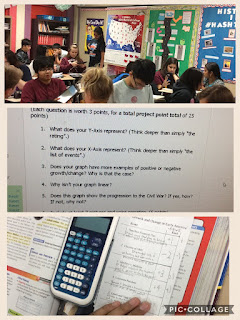
Students have been using math in History this week and I'm eager to hear their reflections today. We have been studying the early years of the American Republic and I created an overarching unit to tie these events together. Using the theme of growth and change, each student began by reviewing 9 events/ideas and individually ranked them on a scale of +5 (positive change/growth) to -5 (negative change/growth). In group meetings, these historians were asked to average their findings and develop 2 justifications for their averages. The next step was to graph their findings. I gave them graph paper (the x-axis labeled "events 1-9", the y-axis labeled "rating") and the groups created their graphs. The final step was to create a Spark Video analyzing their data. They needed to more thoroughly explain the x-axis and y-axis (possible answers: the events show the growth and change of the country over time from Washington's Administration to the Missour...

Using the Engineering Design Process in History Education

We all have our strengths. I have learned long ago that science and math aren't strengths of mine but I've continued to challenge myself in areas of weakness in order to grow. My Business Calculus college course comes to mind--I've never been prouder of a sub-par grade before! (I also didn't need the class to graduate when I switched majors!) Another realization I've made over the years is that the need to provide opportunities and connections for my Historians that aren't necessarily in my realm of expertise is important. This might give students their "aha!" moment and help them see the impact social studies has on their lives. It's up to me to step out of my comfort zone and provide this. I implemented Genius Hour in an elective course two years ago and promised myself it would be put into practice in History this year (using the National History Day competition structure). While researching Genius Hour makerspaces and the engineering...

Presidential Primary Source Project Video Conference Opportunity

Image
Today my school had the opportunity to take part in an interactive video conference, with great success! Project details, according to the organizers: The National Park Service, U.S Presidential Libraries, and Museums, the Internet2 community, and cultural and historic organizations nationwide are proud to offer the annual  Presidential Primary Source Project (PPSP) , a series of free, standards aligned, 45 minute interactive videoconferencing programs aimed at students in grades 5-12. The series will run from January - March 2016. Each program will also be live streamed and recorded for on demand viewing for free. I signed up for the program about President Grant, titled  "Daughters of Freedom:  Ulysses S. Grant and the Rise of the Women's Rights Movement" from the  Ulysses S. Grant National Historic Site, St. Louis, MO. This topic relates to the US History content I teach and Womens' History is also interwoven into the activity. I thought about jus...