Posts

Life in the North Pictograph

Image
Students today are demonstrating their understanding of life in the North by creating a pictograph. The factual information students draw into their pictograph will prove that they understand the uniqueness of the North before the Civil War. When students are assessed in this way they show their "Big Picture" knowledge of a topic and that will in turn help them remember history in a powerful and meaningful way. Students will complete a pictograph about life in the South after we've studied that subject and will write about the similarities and differences in both pictographs.  
Industrial Revolution Haiku--Student Work

Here are some of the completed haiku. The students did a very good job of capturing the essence of working in an New England textile factory in the 1800s. Their hands were destroyed Tough work in the hot summer The work was boring                                                                 --Nick, Joel, Neil and Ganesh Stuffy, hard to breathe Cotton whirls about in the light Small cuts dot my hands                                         ...

Industrial Revolution Haiku

Students have been learning about the Industrial Revolution in the mid1800s and how it changed life in New England. Today students processed their learning by creating haiku poems on the subject. They were challenged to think about and evaluate this topic within the structure of a haiku, a 3 line poem with 17 total syllables--5 in the 1st and 3rd lines and 7 in the second line. The poems have been impressive and some will be posted here soon.

Manifest Destiny See-Think-Wonder Activity

Image
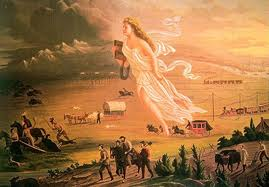
Students spent some time analyzing artwork that captures the idea of Manifest Destiny, or the belief that Americans in the 1800s felt they deserved to have their land extend "from sea to shining sea". The painting, "American Progress" by John Gast, is full of detailed examples of the positive and negative effects of Manifest Destiny. Students began their work writing what they saw in the painting and what those items made them think  and wonder about. The following discussion proved that students used deep thinking to extend their knowledge of this time period. This is one of my favorite activities because I love incorporating art into US History and it makes me happy when my students can relate what they see in art to what we are learning in class. They now have a strong image in their mind when they think of the growth of the western United States.

Monroe Doctrine

Image
Students learned about the Monroe Doctrine (written in 1823) today. This document isn't well known but should be because it sets the American foreign policy course to this day. We spent some time in class discussing how we are the peacekeepers and police force for the world and listed many examples where this was the case. Tomorrow the students will decide if America should take on this role.   This discussion was another great opportunity to integrate 20th and 21st century history into our curriculum.  

Presidential Inauguration

Image
This Monday is the day that President Barack Obama will be sworn into office again to begin his second four-year term.  Inauguration Day is usually always held on January 20th but will change this time because of the 2013 calendar. This information is from the official Inaugural website (the link is found at the end of this post).: ********************************************************************************* When Inauguration Day Falls on Sunday Only six times in the nation's history has the constitutionally-mandated date for a Presidential Inauguration fallen on a Sunday. January 20, 2013 will be the seventh time, and following historical precedent, the public ceremony will be held at the U.S. Capitol on Monday, January 21, 2013. In a tradition that dates back to 1917, the White House will likely arrange a private swearing in before noon on January 20, 2013. ********************************************************************************* There will be many e...

Hamilton and Jefferson

Image
Students are exploring the differences between Alexander Hamilton, first Secretary of the Treasury and Thomas Jefferson. It's interesting for them to see not only how these men viewed government and society back in the late 1700s but also how they are similar to politicans today. While not a perfect match, Hamilton's ideas bear resemblance to the Republican Party's views today and Jefferson has Democratic leanings. There's much to interpret in their differences and it's making for interesting class discussion.